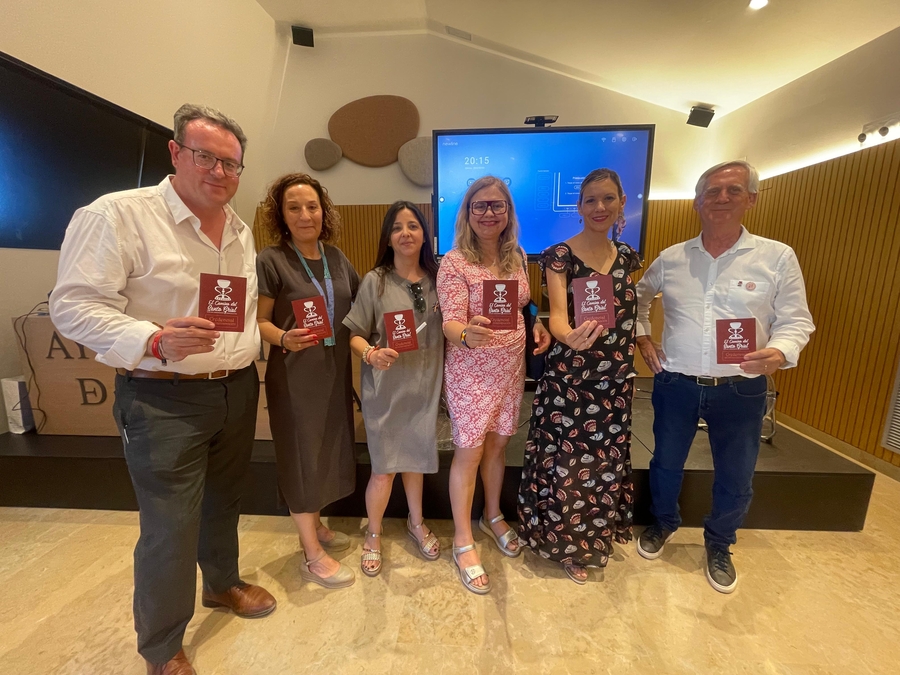
ALBENTOSA, TERUEL, SPAIN, July 05, 2026 /24-7PressRelease/ — The City Council of Albentosa presented last Friday, June 26, the results of the project “The Way of the Holy Grail“, an initiative that has allowed to adapt and improve the cultural itinerary as it passes through the municipality, reinforcing its tourist attraction and its commitment to the sustainable development of the rural environment.
The institutional act was attended by the mayor of Albentosa, Ms. Yolanda Salvador Corella, accompanied by José Luis Alvira, president of the Gúdar-Javalambre region; Ana Cris Lahoz, provincial deputy of Teruel; and Beatriz Martín, first vice-president of the Provincial Council of Teruel, who learned first-hand about the actions carried out and the impact that this project will have for the future of the municipality.
The initial project was conceived and developed by Dr. Ana Mafé García, president of the Cultural Association El Camino del Santo Grial and an expert in tourism in the development of cultural itineraries, who designed a strategic proposal aimed at turning cultural heritage into an engine of territorial development, entrepreneurship and creation of opportunities for the municipalities of the interior.
The execution of the project has been possible thanks to the commitment of the Albentosa City Council and the impulse of its mayor, Yolanda Salvador Corella, who opted from the first moment to integrate The Way of the Holy Grail within the tourism development strategy of the municipality. As stated in the institutional presentation, the collaboration initiated with Dr. Ana Mafé García and the International Association Cultural Itinerary ‘The Way of the Holy Grail’ in Europe opened new opportunities for Albentosa and laid the foundations of the project that is now a reality.
“The Way of the Holy Grail” project has been fully implemented thanks to the financing of the European Next Generation EU funds, within the Recovery, Transformation and Resilience Plan (PRTR), which amount to two million euros, making possible a broad investment in infrastructures, accessibility, signage, improvement of urban space, digitalization, tourist communication and valorization of heritage cultural and natural of the municipality. Among the actions carried out are the improvement of trails, the creation of tourist routes, the rehabilitation of the pilgrims’ refuge, the signposting of the itinerary, the adaptation of accesses, urban beautification and various promotion and training actions.
At the same time, the tourism promotion of The Way of the Holy Grail in Aragon is developed within the Strategic Plan of Subsidies of the Department of Environment and Tourism of the Government of Aragon, approved by the Minister of Environment and Tourism, reinforcing the dissemination of this cultural itinerary as an opportunity to revitalize the territory, strengthen the business fabric and generate new opportunities for sustainable development.
With this action, Albentosa consolidates itself as one of the municipalities of reference in the enhancement of The Way of the Holy Grail, demonstrating how cooperation between public administrations, cultural entities and scientific knowledge can be translated into real projects capable of promoting the economic, tourist and social development of the Aragonese rural environment.
Holy Grail tour of Aragon from the third to the fourteenth century
After its arrival in Hispania, tradition places the Holy Chalice in Huesca, the birthplace of Saint Lawrence, where it would have been sent from Rome during the persecutions of Emperor Valerian in the third century to preserve the sacred relic.
With the advance of the Muslim occupation of the Iberian Peninsula in the eighth century, the Holy Grail was successively transferred to different places of safety in the Aragonese Pyrenees until it was kept in the Monastery of San Juan de la Peña, one of the main spiritual and political centres of the Kingdom of Aragon. There it remained protected for several centuries, becoming one of the most significant episodes in the historical tradition linked to the Holy Grail and consolidating the monastery as one of the most emblematic heritage sites in Europe.
From this historic centre, The Way of the Holy Grail runs through some of the most representative territories of the ancient Kingdom of Aragon. The itinerary crosses municipalities of extraordinary historical, artistic and scenic value such as Jaca, the first capital of the kingdom; Bailo, linked to the first Aragonese monarchs; Santa Cruz de la Serós, with its exceptional Romanesque ensemble; Loarre, presided over by its imposing medieval fortress; Huesca, birthplace of San Lorenzo; Zaragoza, historical capital of the Crown of Aragon; Daroca, a monumental city of great relevance on medieval routes; and Teruel, a universal reference of Mudejar art declared a World Heritage Site by UNESCO.
This route makes Aragon the backbone of a cultural itinerary that integrates history, heritage, landscape, scientific research and sustainable territorial development, highlighting the contribution of its municipalities to the conservation and transmission of one of the most important cultural traditions in Europe.
Report by Will McCarthy
’24/7 Valencia’ magazine
—
For the original version of this press release, please visit 24-7PressRelease.com here
Legal Disclaimer: The content on this page is syndicated from independent third-party providers. Kyrion Media makes no warranties or representations regarding the accuracy, completeness, legality, or reliability of the information, including text, images, videos, or licenses. If you are affiliated with this content or have any complaints, copyright concerns, or requests for removal, please contact us at retract@kyrionmedia.com with the specific URL of the content in question. We will review and address valid requests promptly.