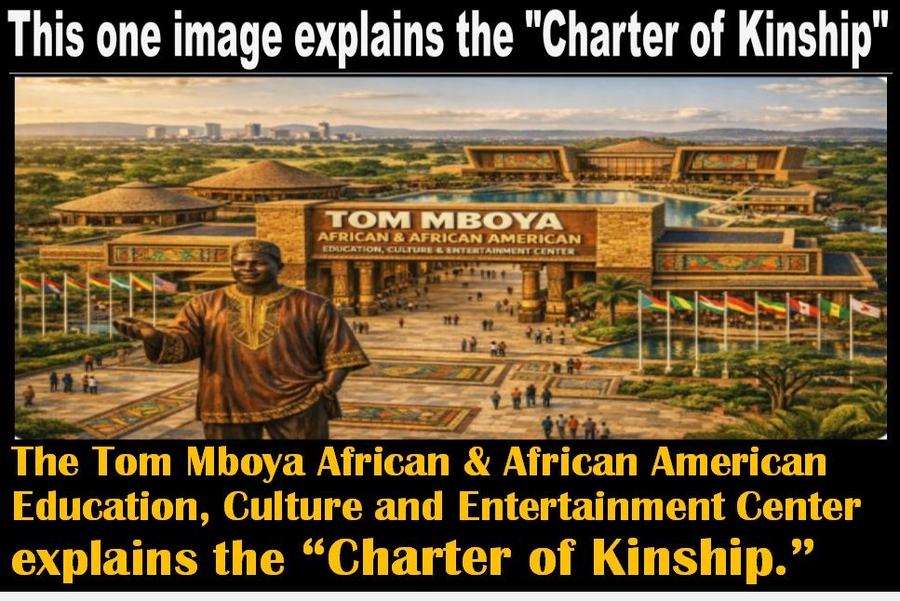
MEMPHIS, TN, May 06, 2026 /24-7PressRelease/ — There is a saying “One Picture is worth 1000 Words.” The AI image of “The Tom Mboya Education, Culture and Entertainment Center” proposed to be built in Nairobi, Kenya in East Africa explains the “Historic Charter of Kinship” proposed by Memphis born “African Cultural Ambassador,” Five time World Kickboxing Champion, Historian and Community activist Anthony “Amp” Elmore.
The Subtitle of the story is: “How a 1990 Kenyan Film Premiere Launched the First Industrial-Level Trade Deal between an African Government and a Black American Business, Defining Orange Mound as a Global Sovereign Hub.”
Click here to view the You tube video titled: “Charter of Kinship: The Official Anthem”
The 4-minute video in a nutshell via Black Music Culture tells the story of the unknown and untold story of Kenya and its connection to Black America. It notes that the 26 year old African Tom Mboya came to America in 1956. His dream was that Kenya would be free some. The lyrics say “If Kenya was to be an independent Nation the youth of Kenya needed an Education, whereas Tom Mboya started a program called “Airlift America and Tom Mboya won” whereas one of the Kenyan students has a famous son; Barack Obama Jr. Tom Mboya promoted “Harambee a word that means “all put together.”
The song tells that in 1969 Tom Mboya was shot down and the people are still crying. The song states that that the people should not cry because his “spirit shall rise again.” It is in the African American community of Orange Mound whereas “The Tom Mboya Sprit Rise Again.” The song ask Kenya President Dr. William Ruto to come to Memphis and honor the legacy of Tom Mboya via joining with African/Americans to build the “Tom Mboya education, culture and entertainment center in Nairobi, Kenya. The center would be the largest such center to celebrate Black Culture in world history.
A visit from President Dr. William Ruto to Orange Mound is significant because it would provide the first 21st-century presidential validation of this sovereign bridge, acknowledging that the road to African independence and Black American self-determination is paved with trade, not aid.
Click here to view the website titled: charter of Kinship. Com
Orange Mound is uniquely significant in this global framework because its 147-year history of self-reliance—founded by two Black churches in 1879—predates the cultural rises of Harlem and Atlanta, positioning it as the original American site of Black agency. By linking the ancient “Mound Builder” heritage to modern cinematic and diplomatic achievements, Orange Mound stands as the definitive “Returning Point” where the Diaspora can experience a home based on education, culture, and sovereign economic power.
In the Historic African/American Memphis Community of Orange Mound sits “The African Cultural Embassy” founded by Anthony “Amp” Elmore. The African Cultural Embassy is a “Sovereign African and African American Institution” founded by Anthony “Amp” Elmore.
Click here to visit the website: African Cultural Embassy .Com.
The African Cultural Institution fights Whites Supremacy, Racism and Black on Black Racism whereas the institution makes “Historical Corrections.” Elmore explains the greatest Historical correction the “African Cultural Embassy” battles is the White Supremacy, Racism and Black on Black racism in both Africa and in America.
Dr. Martin Luther King Jr. said “Silence is Betrayal.” Anthony “Amp” Elmore notes that both Black African and African/American leaders have betrayed Africa via their silence regarding the White Supremacist narratives of Africa and Africans based on Tarzan and the Jungle.
Anthony “Amp” Elmore explains that today at the time of this posting in 2026 most African/Americans believe that Africa is a “Monolithic Country full of wild animals and savages.
The “Tarzan” narrative and the pervasive miseducation surrounding Africa constitute one of the most successful and damaging psychological assaults in human history, designed to strip a global people of their sovereign identity and economic power. By weaponizing film, literature, and media to portray a continent of 54 diverse nations as a “monolithic country” of jungles and savages, systemic White supremacy has effectively severed the connection between the **$2.1 trillion African American economy** and its ancestral industrial roots.
In 2026, this “Information Blockade” remains so potent that it traps many African Americans in a state of manufactured fear—where the anxiety of being “eaten by wild animals” supersedes the reality of engaging with sophisticated 21st-century leaders like **President William Ruto.
This miseducation is not an accidental misunderstanding but a strategic tool of control; by keeping the Diaspora ignorant of Africa’s high-tech hubs, sovereign trade potential, and diplomatic brilliance, the architects of this narrative ensure that Black wealth remains circulating within Western systems rather than fueling a unified, global Black empire.
This global assault is precisely what Anthony “Amp” Elmore challenges through the African Cultural Embassy and the “Forensic Receipts” of the 1990 trade deal in Kenya. By exposing the “Tarzan” myth as a colonial fiction, Elmore replaces fear with the Charter of Kinship, transforming the narrative from one of “savagery” to one of **Sovereign Diplomacy**.
The 2026 Tom Mboya celebration and the proposed Education, Culture, and Entertainment Center serve as the ultimate antidote to this miseducation, providing a physical space where the “True Africa” is revealed. For the first time, African Americans are being invited to stop viewing the continent through the lens of a “monolithic jungle” and start viewing it as a high-value partner in a shared destiny, effectively dismantling the psychological chains of the Tarzan era to build a future based on industrial and cultural self-determination.
Click here to learn about the Tom Mboya 70th Celebration in Memphis dated August 15, 2026.
If it was not for Tom Mboya there would never have been America’s 1st African/American President Barack Obama Jr. Tom Mboya came to America on his 26th birthday August 15, 1956. The African Cultural Embassy celebrates Tom Mboya’s 70th noting 70 years since he 1st came to America.
In regards to Black Americans believe that Africa is a jungle with natives caring spears and a shield is a common misconception that reduces a massive, diverse continent into a single, narrow narrative. Africa is home to 54 countries, thousands of distinct ethnic groups, and a vast array of languages, landscapes, and modern urban centers.
The idea of Africa being “monolithic” is often fueled by a lack of historical context and media stereotypes. When people overlook the continent’s complex history, economic growth, and cultural diplomatic influence, they miss the reality of a place that is incredibly multifaceted.
Instead of a single story of “wild animals” or “savages,” a more accurate view recognizes vast Diversity: From the tech hubs in Nairobi and Lagos to the ancient history of Ethiopia and the varied climates ranging from the Sahara to tropical rainforests.
The African Cultural Diplomat Exchange Network serves as the operational engine of the African Cultural Embassy, specifically designed to dismantle the “Tarzan” narrative through structured education and technological immersion. Anthony “Amp” Elmore asserts that because the miseducation of Africa is a systematic global project, the correction of that image must be equally systematic, led by a new class of cultural diplomats who possess the “forensic receipts” of African excellence.
By utilizing the 21st-century technology available, the network creates a direct digital and physical pipeline where students and entrepreneurs can engage with the real-time industrial and technological advancements of the African continent. This proactive educational model moves beyond traditional classroom settings to create a living curriculum that replaces the myth of a “monolithic jungle” with the reality of high-tech cities, sovereign governments, and sophisticated trade partners.
For educators and cultural diplomats, the mission is to provide the Diaspora with the intellectual tools necessary to navigate the motherland as savvy investors and kin, rather than fearful tourists. The African Cultural Embassy functions as the “corrective lens” through which the $2.1 trillion African American economy can see its own reflection in Africa’s growth.
By fostering direct exchange programs that emphasize the history of figures like Tom Mboya and the 1990 industrial trade precedents, the network empowers the youth of Orange Mound to lead the charge in global diplomacy. Ultimately, this educational initiative is a sovereign act of self-defense; it ensures that the next generation is no longer victimized by miseducation, but is instead equipped to build the Tom Mboya African & African American Education, Culture and Entertainment Center as a permanent monument to truth and unified prosperity.
The continent has a long history of international relations and trade that predates colonial narratives. Economic & Intellectual Contributions: Africa is a center for innovation in mobile banking, renewable energy, and global arts.
The uploaded graphic of the Tom Mboya African & African American Education, Culture and Entertainment Center serves as the architectural manifestation of the Charter of Kinship, transforming a diplomatic document into a permanent, sovereign homeland for the Diaspora. While a signature from an African leader in Memphis is a necessary legal formality, the image proves that the true weight of the Charter lies in the reciprocal commitment to build a world-class institutional anchor on African soil.
The Tom Mboya African and African American Education, Culture and Entertainment center represents the shift from passive tourism—which focuses on wildlife that holds little interest for Black Americans—to active Sovereign Engagement, where the focus is on a shared heritage, high-tech education, and elite entertainment. By centralizing the history of the “True Africa” and the achievements of Black America in one location, the center provides the physical infrastructure for the **$2.1 Trillion African American GDP** to be invested directly into the motherland, moving beyond a “lack of vision” toward a structured, industrial future.
The correlation between this center and the Charter of Kinship is one of “Vision and Validation”; the Charter provides the legal framework of family, but the Center provides the Sovereign Entity where that family resides, learns, and prospers. It functions as the ultimate “Return Point,” ensuring that the connection between Orange Mound and Kenya is not merely symbolic but built on the solid ground of economic self-determination and mutual development.
For African Americans, this is the end of the “Tarzan Myth” and the beginning of a homecoming based on dignity and industrial partnership. This vision for the Tom Mboya Center is the physical proof of a “Marshall Plan for All Africa,” where Africans and African Americans come together to build a global gateway that honors the past while financing a sovereign, independent future.
The Historic Charter of Kinship represents an unprecedented milestone in the annals of world history—the first time a national government, a regional county government, and a traditional spiritual authority have formally recognized not merely a municipality, but a specific African American community as a sovereign cultural entity. This Charter is a tri-continental alliance between the Government of the Republic of Kenya, the County Government of Kisumu, the Luo Council of Elders, and the historic community of Orange Mound in Memphis, Tennessee.
It serves as a forensic reclamation of the “Invisible Thread” that has bound these two peoples together for seventy years, moving beyond the sterile language of “sister cities” into the sacred territory of “Official Family.” By formalizing this bond, the Charter establishes Orange Mound as a primary node in the global African Diaspora, ensuring that the blood-ties forged during the 1956 African Airlifts are never again “whited-out” by political bureaucracy or colonial erasure.
The historical foundation of this Charter rests upon the corrected forensic record of Orange Mound’s birth. While mainstream narratives have long peddled the myth of an 1890 founding by white developer E.E. Meacham. The Charter Kinship serves as the definitive legal and spiritual recognition that Orange Mound was born in 1879 through the independent agency of Mt. Moriah Baptist Church and Mt. Pisgah CME Church.
These sacred institutions did not just build buildings; they built a fortress of Black sovereignty and spiritual independence that predates the very birth of the Kenyan Republic. Because of this deep-rooted history, the Charter designates Orange Mound with the highest honor ever bestowed upon a Black American neighborhood.
Orange Mound is noted as “The Birthplace of African Cultural Diplomacy.” Furthermore, in honor of the man who bridged the gap between the American South and East Africa, the community is formally recognized under this Charter as the Tom Mboya Legacy District. This title that binds the soil of Memphis to the legacy of the man who engineered Kenyan independence.
This Charter is a direct answer to the call for unity championed by Dr. Martin Luther King Jr. and Tom Mboya in 1959. These two titans recognized that the struggle for Civil Rights in America and the struggle for Uhuru in Kenya were the same heartbeat. The Charter of Kinship honors their shared vision of a “Global Black Family” that operates as a single economic and cultural engine. It is a bold rejection of the “2024 Dr. William Ruto Presidential Snub,” providing a forensic audit that demands the current Kenyan administration recognize the Black American hands that funded their freedom.
We call upon our friend Memphis Congressman Steve Cohen to take this Charter to the **Floor of the United States Congress, ensuring that this world-first recognition is entered into the Congressional Record as a matter of national importance. Furthermore, we submit this Charter to UNESCO joining the relationship between Orange Mound and Kenya to be recognized as an Intangible Cultural Heritage of Humanity, a forensic receipt of a cross-continental kinship that survived the middle passage and the colonial era.
The spiritual and physical climax of this Charter will manifest on August 15, 2026, during the Tom Mboya 70th Anniversary Celebration. On or around this historic date of Sunday August 16, 2026 we ask Mt. Moriah and Mt. Pisgah—the foundational churches of Orange Mound tol spiritually connect in prayer with Kenyans to the Luo Council of Elders and the leadership of Kisumu County.
This is a diplomatic mission to close the “Invisible Thread.” For the first time in history, the descendants of those who built America’s first independent Black community will stand as equals with the guardians of the Luo heritage, fulfilling the prophecy of a reunited family. This event will serve as a global demonstration of Spiritual and Cultural Sovereignty, proving that the connection between Orange Mound and Kenya is the most significant international achievement of the Civil Rights Movement.
By signing this Charter of Kinship, the participating parties recognize that the prosperity of Kisumu and the prosperity of Orange Mound are inextricably linked. We are establishing a new “Safari Initiative” that bypasses traditional government roadblocks to create direct trade in culture, education, and commerce. This Charter is the ultimate honor for the people of Orange Mound, transforming their community from a “neighborhood” into a Global Diplomatic Hub.
It is a testament to the fact that while history can be hidden, the truth of kinship is eternal. We invite the President of Kenya, the leaders of UNESCO, and the citizens of the world to witness this birth of a new era, where the “Invisible Thread” is finally made visible for all of humanity to see.
The significance of Orange Mound in the tapestry of American and global history lies in its status as a premier site of Sovereign Black Agency, predating the cultural rise of both Harlem and Atlanta as hubs for the African Diaspora. While Harlem became a destination for African leaders like Haile Selassie, Kwame Nkrumah, and Nelson Mandela in the 20th century, Black residents did not move into that community in significant numbers until the early 1900s; in contrast, Orange Mound’s foundation was laid in 1879 by two Black churches, establishing it as the first community in the United States built specifically for and by Black people.
This earlier date is critical because it connects Orange Mound to an ancient, pre-European heritage, with Anthony “Amp” Elmore linking the neighborhood’s legacy to the Mali “Mound Builders, asserting that the first Americans were of African descent and not merely European settlers or Asian migrants. By centering this history, Orange Mound provides a “forensic receipt” for the Native American roots of many African Americans, proving that Black people were the architects of their own sovereign land long before the modern civil rights era.
In the realm of African Cultural Diplomacy, Orange Mound holds a unique superiority over Harlem and Atlanta because it serves as the physical home of the Tom Mboya Legacy District and the African Cultural Embassy. Orange Mound—through Elmore’s research—restores the 1959 history** of Dr. King welcoming Tom Mboya to facilitate the student airlifts that changed the course of world history.
The upcoming Tom Mboya 70th Anniversary in 2026 and the Charter of Kinship codify this neighborhood as a global sovereign hub that negotiates directly with African governments, bypassing traditional Western power structures. Ultimately, Orange Mound is more significant because it represents a continuous 147-year mission of self-determination, linking ancient African mound-building technology to 21st-century diplomatic trade, and establishing the neighborhood as the definitive “Returning Point” for the $2.1 trillion African American economy.
The African Cultural Embassy’s mission of “Historical Correction” is rooted in a unique, providential bond of shared heritage that transcends modern borders, leading Anthony “Amp” Elmore to appeal directly to Kenya President Dr. William Ruto as a brother and a peer. This spiritual and diplomatic lineage was forged in 1992 when the late Kenyan President Daniel Arap Moi officially named Elmore an **”African Ambassador,”** a title that established a lifelong mandate to bridge the two worlds. Because President Ruto is both a fellow Kalenjin and an honorary Luo Elder, Elmore views their connection not as a matter of distant statecraft, but as a familial duty between brothers.
Drawing a powerful parallel to the film The Color Purple, where Celie warns Mister that mistreatment of family leads to a spiritual decline, Elmore asserts that Kenya must finally “do right” by the legacy of **Tom Mboya**, whose transformative history was systematically erased by the very nation he helped build.
The proposal for the Tom Mboya African and African American Education, Culture and Entertainment Center in Nairobi is presented as a plan “from the Gods,” intended to be the largest institution of its kind in the world. It is a moment of divine providence that a man named as an African Ambassador by President Moi would now bring this vision to President Ruto, inviting him to leave the formal halls of state to share a meal of **Ugali and Sukuma Wiki** at a sovereign embassy in Black African American neighborhood in Orange Mound in Memphis.
The point that we want President Ruto is to introduce African Culture to America. Just as Shushi from Japan was introduced to America. Black Americans via “Ugali and Sukuma” can be introduced to Africa’s Collard greens and Cornbread.
This gesture signifies that the path to global Black unity is not found in Western aid, but in a shared plate and a shared vision. By supporting this center, President Ruto has the opportunity to heal the historical rift caused by the erasure of Mboya’s work, finally uniting the **$2.1 trillion African American economy** with Kenya through a permanent monument of education, culture, and industrial kinship.
Why our Charter of Kinship Is a World‑First Diplomatic Instrument
The Charter of Kinship stands as a world‑first diplomatic instrument because no African American community in history has ever been formally recognized by an African nation, a regional government, and a traditional spiritual authority as a sovereign cultural entity. Unlike symbolic “sister‑city” agreements or temporary cultural exchanges, this Charter establishes a binding tri‑continental alliance rooted in documented historical ties, shared ancestry, and a 70‑year record of cooperation between Memphis and East Africa.
It is the first time that a national government, a county government, and an indigenous council of elders have jointly acknowledged an African American community not as visitors, tourists, or descendants, but as official kin with sovereign cultural standing. This elevates Orange Mound from a neighborhood into a recognized node of the global African Diaspora, creating a diplomatic category that has never existed before.
What makes this Charter unprecedented is its foundation in forensic historical evidence rather than symbolic goodwill. The document draws upon the corrected 1879 founding of Orange Mound by Mt. Moriah Baptist Church and Mt. Pisgah CME Church, the 1956–1959 alliance between Tom Mboya and Dr. Martin Luther King Jr., the 1990 industrial trade deal in Kenya, and the 1992 appointment of Anthony “Amp” Elmore as an African Ambassador by President Daniel Arap Moi.
No other African American has ever presented a multi‑decade chain of documented diplomatic engagement strong enough to justify a sovereign Charter. This transforms the Charter from a cultural gesture into a legally and historically grounded instrument that reclaims the erased contributions of African Americans to African independence movements.
The Charter is also a diplomatic first because it establishes a Return Point on African soil through the proposed Tom Mboya African & African American Education, Culture and Entertainment Center in Nairobi This Center is not a museum or tourist attraction; it is a sovereign homeland for Diaspora engagement, designed to unite the $2.1 trillion African American economy with African industrial development. No African American community has ever created a permanent, government‑supported institution on the African continent dedicated to education, culture, trade, and diplomatic exchange. By linking this Center to the Charter, the document becomes both a legal covenant and an architectural blueprint for a new era of African Cultural Diplomacy.
Equally groundbreaking is the Charter’s integration of spiritual authority with political authority. The inclusion of the Luo Council of Elders elevates the agreement beyond modern statecraft into the realm of ancestral legitimacy. African diplomacy rarely merges governmental power with traditional custodians of heritage, yet this Charter unites both, acknowledging that kinship is not merely political but sacred. This fusion of ancestral recognition, governmental partnership, and Diaspora sovereignty has no precedent in African or African American history.
Finally, the Charter of Kinship introduces a new diplomatic category: Kinship Diplomacy. It moves beyond treaties, trade agreements, and cultural exchanges by establishing a formal family bond between two communities separated by the Middle Passage but reunited through shared struggle, shared history, and shared destiny. It is the first diplomatic instrument to declare that the prosperity of an African American community and the prosperity of an African region are inextricably linked. In doing so, it fulfills the unfinished vision of Tom Mboya and Dr. King, transforming their dream of a global Black family into a legally recognized reality. This is why the Charter of Kinship is not only historic — it is the beginning of a new diplomatic era.
The Elmore Vision: The Daily Heritage Line to Africa
The center of Anthony “Amp” Elmore’s 21st-century vision for Africa is the establishment of a Daily Heritage Flight, a direct airline route connecting Black America to Kenya every single day. This is not merely a transportation system; it is a “Sovereign Air Bridge” designed specifically to make the Tom Mboya African and African/American Education, Cultural and Entertainment Center]a functional reality for the Diaspora.
By creating a consistent, daily corridor between these two worlds, Elmore’s vision effectively dismantles the 114-year-old Tarzan Narrative of a “distant, unreachable jungle” and replaces it with a convenient, modern habit of cultural exchange. This direct line serves as an educational pipeline, allowing Black students to travel to the continent as a formal part of their curriculum, moving back and forth between the U.S. and Nairobi with the same ease as a domestic commute.
To ensure this vision is both affordable and convenient, the system would utilize the collective economic power of the $2.1 trillion Black American GDP to subsidize “Heritage Seats” for students and families. By arranging a high-frequency schedule, the airline would achieve economies of scale, significantly lowering the cost of international travel and turning a once-in-a-lifetime pilgrimage into a frequent, accessible educational experience.
This daily frequency ensures that the Tom Mboya Center remains a “Living Archive” and a thriving hub of entertainment and trade, rather than a static monument. Ultimately, the Daily Heritage Line transforms African Cultural Diplomacy into a mechanical reality, proving that the “Invisible Thread” is now a physical, high-speed connection that reclaims the sky for the Global African Family
About Us
“If Lions were historians, hunters would no longer be heroes.” This powerful African proverb encapsulates the mission of the Orange Mound News Network (OMNN). Founded by Anthony Amp Elmore, OMNN aims to reclaim and reshape the narrative of Orange Mound through the power of filmmaking, education, and content creation. Our goal is to challenge the negative stereotypes and biased portrayals that have long plagued our community, creating a positive space for family, Black culture, history, and education.
Our Journey and Mission
Orange Mound, established as the first community in America built for Blacks by Blacks, has a rich history often overshadowed by negative stereotypes. Mainstream media and societal biases have painted Orange Mound as a “ghetto,” contributing to a 30% decline in property values while surrounding communities have prospered.
The Orange Mound News Network was created to counter this narrative and highlight the true spirit and resilience of our community. Anthony Amp Elmore, a five-time world karate kickboxing champion, filmmaker, and community activist, has been a beacon of change in Orange Mound. With over five decades of community service, Elmore has dedicated his life to uplifting Orange Mound. From becoming a homeowner at 19, establishing businesses, to founding the Proud Black Buddhist World Association, Elmore’s contributions have been immense.
—
For the original version of this press release, please visit 24-7PressRelease.com here
Legal Disclaimer: The content on this page is syndicated from independent third-party providers. Kyrion Media makes no warranties or representations regarding the accuracy, completeness, legality, or reliability of the information, including text, images, videos, or licenses. If you are affiliated with this content or have any complaints, copyright concerns, or requests for removal, please contact us at retract@kyrionmedia.com with the specific URL of the content in question. We will review and address valid requests promptly.