LONDON, ENGLAND, August 06, 2026 /24-7PressRelease/ — Three American AIs and an American/UK tech team of humans have created a viable unique canal proposal for bypassing the Strait of Hormuz
Despite Iran being partly disarmed Iran keeps blackmailing the Western world via fear of what it ‘could’ do to ships.
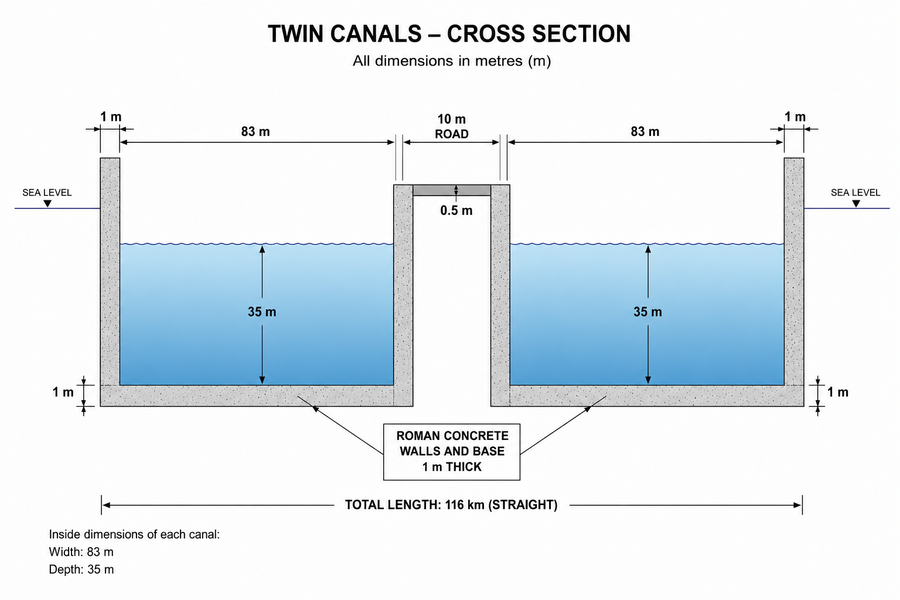
Seven humans and three AIs worked to solve all the barriers to building a bypass canal and came up with two 116km long sea level narrow (83m wide)canals each capable of handling VLCCs, running from Fujairah Port to Sharjah Port Khalid. It is all inside the UAE which would become the regional power as the canals would enable continuous export of Gulf oil, gas and goods while avoiding the Iranian coast by hundreds of miles.
It would save each VLC Tanker 18 hours and 350nm ($60,000 Time Charter Equivalent) as well as insurance war premiums.
The proposal creates double safety net with the UAE pipeline system and the inland maritime canal system.
Apart from a myriad of other proposed defences, a small Chinese interest, would guarantee any threat would be a declaration of war on China.
Francis Sullivan a spokesman for the human/AI consortium told us “Our target was to see if we could build a canal system in under 5 years and costing less than $100 billion including reusable mega cutting equipment. The reason that this has not been proposed in this form before was because humans and AIs have never been able to work like this before. The solutions are cleverer than humans could achieve on their own. If this is adopted no ships other than Iranian vessels will pass through the Strait of Hormuz by around 2031.”
WHY IS A NEW CANAL POSSIBLE NOW
Conventional planning, ideas and equipment has made the prospect too expensive, too slow and unimportant before Iran’s ability to stop shipping was fully exposed.
Too expensive
High costs within conventional Hormuz bypass canal plans have centred around very large construction workforces paid for 15 years, manual removal of 4 billion tonnes of waste, attritional destruction of conventional quarrying/mining/tunnelling heavy equipment and even excessive management costs. By cutting build time down to 5-6 years the workforce is engaged for far less time. Drones are used extensively along with instant sampling. The Chinese mega engineers include final surveys in their costs but all of the route has been surveyed, so the Gulf management company does not need to replicate this. The twin canals only total 160m in width and so this dramatically reduces the volume of waste. Much of the waste rock is also crushed, and laser fused by the machines to be used in the construction. The system also involves mechanised continuous waste removal. Although conventional heavy equipment is used to allow a day one start, this is rapidly replaced with new purpose built modular machines designed to have a long life for future projects.
Too slow
Using agentic AIs, drones and Chinese mega engineering shortens the environmental assessment , engineering design and procurement phase dramatically, construction and installation could be shortened to 2- 3 years, and testing and commissioning (3-6 months).
The main challenge to the trans-Emirates canal is the Hajar Mountains, which rise to heights above 1,800 metres and consist mainly of ophiolite rock formations. There will need to be some compromise on environmental issues. The plan is to have five teams starting simultaneously. One for each end of the two canals and one starting the heavy high mountain work (using traditional and laser fusing methods) all from day one. Although using conventional equipment to begin with this allows for rapid progress until the Chinese built mega equipment is available. However the use of specialist Chinese mega AI driven project engineering teams (who for example built a 135km canal recently in 5 years) is the primary reason this can be fast. Chinese build to a timetable and meet deadlines while retaining engineering integrity.
Geopolitical challenges
The UAE obviously owns the land and would be lead owners in partnership with funders but there are advantages in having other countries as part of a consortium. Cooperation could be via the Gulf Cooperation Council member states who could work with the UAE to coordinate re-routing inland via Sharjah through Fujairah. Others could include global energy importers, particularly Japan, India(despite Oman pipeline), and South Korea. However the key is that if China is part of that ‘group’ then control documents can be worded so that if anyone attempted to sabotage either canal it would be an attack on China. Agreements would need to cover ownership, management, fly zones for inspection drones and ingress and egress deep port agreements.
CORE PLAN
Once funding, ownership and management are agreed and Chinese teams/companies are contracted then the build can begin.
A phased programme delivering:
1.Build Mega machines in China
Build AI controlled canal megastructure machinery for this and future global projects. The machines are unique utilising self propelling architecture and multiple cutting processes such as laser, water jet and zirconia wheels. Although machines are modular they combine to cut, dispose of waste, ‘fix’ sides and surroundings and layer the base and sides of the canals.
2. Use conventional equipment at both ends and mountain area from day 1
There is no need to wait for the unique machines to be built as there is a large amount of equipment in China and other parts of the world that can be hired, and this is budgeted for. So immediately 5 teams using mining, quarrying and similar large digging equipment starts at both ends and from the area adjacent to the mountain area and on the mountains working on both channels from first day.
Depending on exact location there may be additional dredging approaching the canals.
3. Protected Twin Corridors with passing docks using mega equipment
• Rock-cut, terrain-masked, semi-covered marine corridors for secure transit.
• The canals are made of sealed ‘Roman’ concrete and there is an option to line with basalt.
• Full bidirectional capacity for the largest tankers.
Programme Scale
Component | Cost Range | Timeline
Phase 1 – Create modular cutting and laying machines
Use available equipment( costed within this budget) | $15B | Years 0–2
Phase 2 –Two corridors cut while phase 1 machines built | $70B | Years 2–4
Total (including local facilitation fees) | $85B | 4 years (full build)
First operational capability: ~ 4 years
OWNERSHIP & UAE DOMINANT POWER
Logical ownership would be private control of the machinery in a separate company with the canal controlled by the UAE or if desired multi Gulf State, oil and gas companies, beneficiary countries like South Korea plus China as builder and protection.
USA COULD BE
STRATEGIC DEFENCE PARTNER
Expansion of storage facilities in Fujairah will make the emirate the largest oil storage and trading hub beyond the Strait of Hormuz, establishing its new position in international energy distribution.
The canals plus pipeline infrastructure reduces regional adversaries’ ability to threaten energy transit routes, protects Asian countries’ energy supplies and establish the UAE as a crucial energy market stabiliser.
A diplomatic source said,” Obviously the UAE could afford to own and control this and would become a powerhouse in the Gulf. Chinese involvement is a given but there are strong geopolitical arguments for a compromise where the canal is UAE managed but ownership involves Gulf exporting States and the key customers such as South Korea and Japan. Perhaps if they all made a significant contribution to the cost this would offset the slight loss of influence the UAE would suffer. The USA could play a strategic role.”
WHAT MAKES THIS DIFFERENT
Programme designed by 3 AIs and human team and includes:
• A new class of AI-controlled linear construction machinery capable of executing mega-scale rock-cut corridors at unprecedented speed. Full manufacturing specification will be provided via first feasibility.
• Autonomous geotechnical mapping + adaptive routing AI
• Multi-face rock attack units (laser/waterjet/drill/blast + robotic cutting hybrids)
• Continuous spoil logistics (conveyor + autonomous haul trains)
• Robotic stabilization (shotcrete, bolting, mesh, drainage)
• Modular precast shielding/canopy fabrication systems
• Integrated project AI (real-time optimisation of throughput, safety, cost)
• Modular mega machines reusable for future corridors, canals, rail, defence infrastructure
• Exportable technology capability (particularly to GCC / Africa / Asia)
• Reduces build time by 50 -65%
Captain Richard Byrne CCO of Green Growth Technology:
“This is different because we used our human team and three AIs to look at every technical reason a canal had not been built and we solved those problems.
Everything we did was to enable the construction team to build two 116km long sea level canals each capable of handling VLCCs and Ultra Large Container ship, running in a straight line from Fujairah Port to Sharjah Port Khalid which also bisects the easiest part of the mountainous region.
We decided on 2 canals which can be much narrower at 83m wide and so produce much less construction waste. Although we can tow broken down ships with winches to berthing docks, it also means we can also keep full ships moving in case of a disaster in one canal.
We designed cutting and canal laying systems that are faster. These are mega machines which we have costed and specified and Chinese partners will build very quickly. However as we would use existing equipment on day one on the five starting sites it is a case of the best of the old and new.
The AIs researched automated processes that could deal with sand, silt and rock while using or moving waste material back to where it could be reused. The same system completes the finished canal. That involves some obvious solutions but also laser and water cutting but integrating everything under AI control.
The UAE actually imports rubble for building projects and so any waste we don’t need can be used by them?
One of my areas of expertise is oil spill disasters so our design includes an automated system along the length of the canals that will deal with a ruptured oil tank instantly and allow us to clean up and get back to transit very quickly. There are many other innovations but we can talk about them another time perhaps. This is a safe passage that saves 18 hours and over 350km and the clever tech just makes that happen.
We are negotiating with the three most influential power brokers in the Middle East and funding is not going the be the issue. China is already building mega projects in the UAE and they just built the 134km more complex Pinglu Canal in 4 years, so we know who the construction partners are.
Unlike the Dubai architect Znera proposal that will cost over $600 billion, this will cost under $100 billion over 4 years including the new reusable mega machines. Talk to people like Lloyds List and they will say the cost of going through this canal will always be cheaper than the Strait and some of that could be recovered from ship owners. The elephant in the room is of course, Iran’s reaction and whether the UAE is a target if it owns and controls a real alternative to the Iranian Strait.
Some of our diplomatic team have had off record discussions and of course, with the 3 UAE pipeline systems, the new canals would mean the UAE would be able to deliver anything the Strait of Hormuz can but without Iran’s involvement.
I am sure you know that Gulf countries are currently formally meeting to see if they can cut out the USA and fund Iran development in exchange for peace. That might work, but if China built and then retained a small interest in the canals they could say hitting the canals was attacking China. If the UAE allowed more countries to be involved then there could be a pledge to respond if the IRGC attacked. The problem is that Iranian politicians and the IRGC are not the same. We have therefore also included early warning and laser weapons as the canal is 233 miles away from Iran at the closest point.
We can do this because we just solve problems. So for example we recently created military biofuel that can be made on bases and biocoal for steel production and power stations, when others could not. Our ability comes from understanding that clever humans are really creative but the latest most powerful AIs can expand on that creativity, research millions of potential solutions and stress test everything. So one AI interacts with our nerdy team members and then the other AIs check the human and AI assumptions. Then we produced costed specified plans. This is the future and for example China builds nuclear sub stations or microchip printing machines without prototypes. We say humans create and AIs perfect.
Once people realise this can be done quickly and affordably, we hope a consensus about maximum geopolitical safety will emerge and that will confirm ownership and control. Failing that the UAE may decide to become the region’s major transit power broker all on its own.”
CONTACT
Captain Richard Byrnes
COO of GGT
+44 7501 793137
rbyrnes@iems-uk.com
Francis Sullivan
CEO GGT
+44 7771 994 661
francissullivan@hotmail.com
John Gallagher
Innovation and AI expert
+44 7756 891 092
John.g@greengrowthtechnology.com
Green Growth Technology uses humans and AIs to design, specify and cost solutions such as military biofuel, unlimited electricity and remote food production.
The combination of AIs human creativity provides answers that have previously been analysed as impossible.
—
For the original version of this press release, please visit 24-7PressRelease.com here
Legal Disclaimer: The content on this page is syndicated from independent third-party providers. Kyrion Media makes no warranties or representations regarding the accuracy, completeness, legality, or reliability of the information, including text, images, videos, or licenses. If you are affiliated with this content or have any complaints, copyright concerns, or requests for removal, please contact us at retract@kyrionmedia.com with the specific URL of the content in question. We will review and address valid requests promptly.